Medicare’s GLP-1 Bridge Program: Why So Many Patients Get Turned Away From the $50 Copay
Nothing’s Perfect
I walked into my doctor’s office expecting good news. I’d read that Medicare now covers Foundayo, one of the new GLP-1 weight loss pills, for just $50 a month through something called the Bridge program. Forty-five minutes later, a medical assistant told me I didn’t qualify. That answer sent me down a rabbit hole, and what I found explains a lot about how Medicare drug coverage really works — and who it leaves out.
If you’re a Medicare beneficiary hoping to get Wegovy, Zepbound, or Foundayo at a low copay, this guide walks you through exactly how the Medicare GLP-1 Bridge program works, who qualifies, and why the rules exclude more people than you’d expect.
What Is the Medicare GLP-1 Bridge Program?
The Medicare GLP-1 Bridge program is a temporary CMS demonstration project. It runs from July 1, 2026, through December 31, 2027 — 18 months total. During that window, eligible Medicare beneficiaries pay a flat $50 copay per month for certain GLP-1 medications prescribed specifically for weight loss.
Three medications currently fall under the Bridge program:
- Wegovy (injection and the newer pill form)
- Zepbound (KwikPen injection)
- Foundayo (pill form)
The $50 copay applies no matter which Part D coverage phase you’re in. That said, the payment sits outside your regular Part D benefit. Your $50 doesn’t count toward your Part D deductible or your annual out-of-pocket cap.
Why Medicare Built a “Bridge” Instead of Just Covering These Drugs
Here’s the background most patients never hear. Federal law has banned Medicare from paying for weight-loss drugs since Part D began in 2006. Congress wrote “agents used for weight loss” into the list of excluded drug categories, and that rule stuck for nearly twenty years — even as GLP-1 drugs became some of the most talked-about medications in the country.
CMS couldn’t undo that law on its own. Instead, the agency used its authority to run a demonstration project through the Center for Medicare and Medicaid Innovation. A demonstration project tests a new payment approach on a temporary, limited basis instead of changing the underlying law. That’s why the Bridge program has a firm end date instead of running indefinitely. It’s a pilot, not a permanent benefit.
CMS designed the Bridge to lead into a bigger initiative called the BALANCE Model, expected to launch in 2028. Whether that follow-up program actually happens depends on funding, political will, and the results of the Bridge pilot itself. Nothing about it is guaranteed.
Who Actually Qualifies for the $50 Copay?
This is where most patients get tripped up. CMS built the eligibility rules around your body mass index (BMI) and specific diagnosed health conditions. You also need to already be enrolled in a Medicare Part D plan. From there, you qualify if you meet any ONE of these three paths:
- BMI of 35 or higher — no other condition needed.
- BMI of 30 or higher, plus a diagnosis of heart failure, uncontrolled hypertension, or chronic kidney disease.
- BMI of 27 or higher, plus a diagnosis of prediabetes, a previous heart attack, a previous stroke, or symptomatic peripheral artery disease.
CMS checks these criteria against the point when you first started GLP-1 therapy, not necessarily today. So if you started the medication years ago at a higher BMI and have since lost weight, your prescriber can attest that you met the criteria at the start of treatment.
The Exclusion Nobody Warns You About
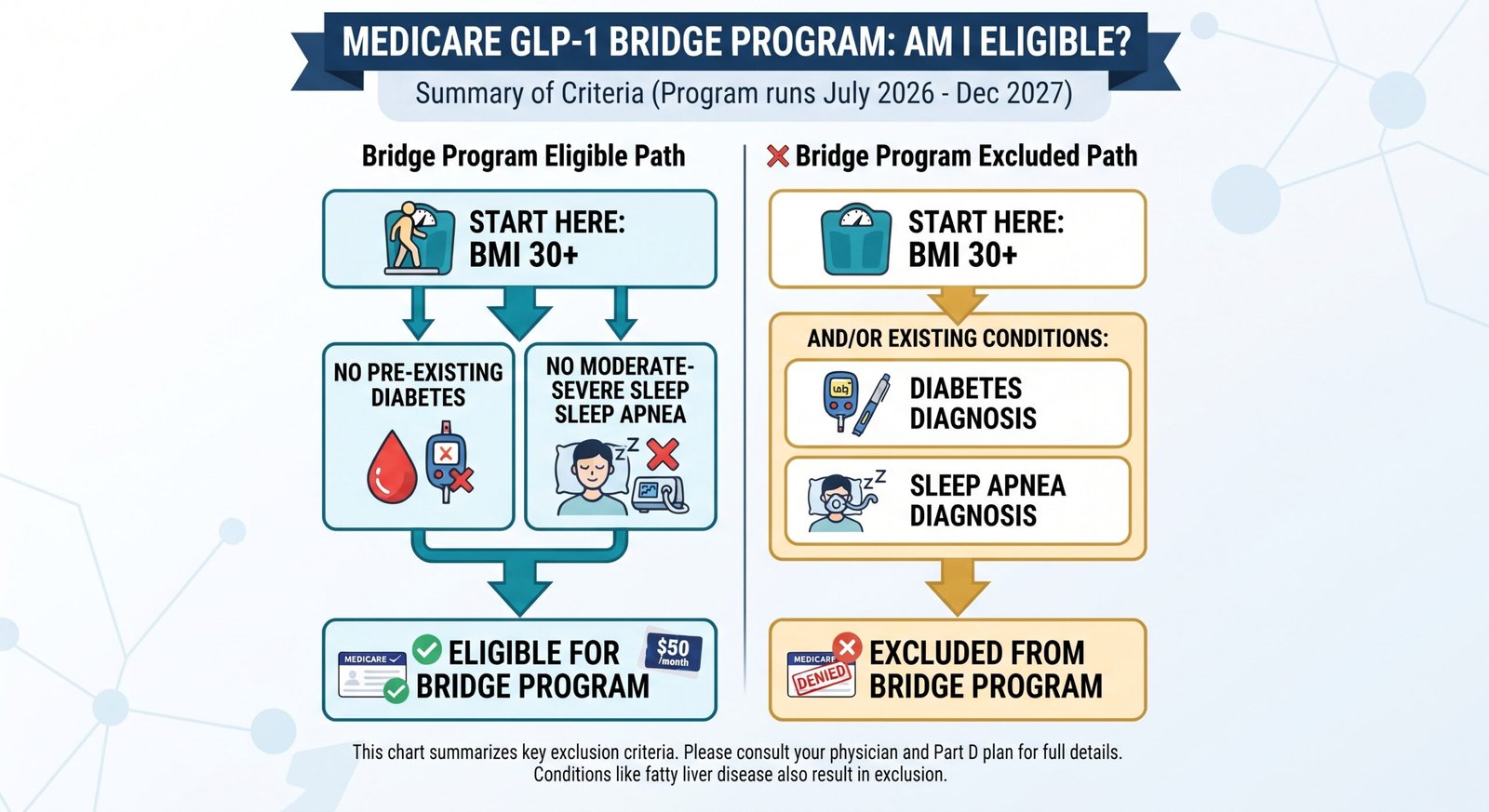
Here’s the catch that caught me off guard, and it might be why you got turned away too. If you already have type 2 diabetes, moderate-to-severe obstructive sleep apnea, or MASH (a form of fatty liver disease), and a GLP-1 is already available to you through standard Part D coverage for that condition, you don’t qualify for the Bridge program.
In plain terms: the Bridge program covers GLP-1s only when the prescription is written for weight management, not for a separate condition that already has its own coverage path. Zepbound, for example, carries an FDA approval for moderate-to-severe sleep apnea in patients with obesity. If your doctor prescribes it for that reason, the drug maker’s normal Part D pricing applies — not the Bridge program’s $50 flat rate.
I can’t tell you why CMS drew the line exactly there, but I can tell you what it looks like from where I’m sitting. GLP-1 makers have spent years working to get these drugs approved for conditions beyond weight loss — sleep apnea, heart disease, kidney disease, type 2 diabetes. Every new approval lets the manufacturer sell the same drug under a different, often more profitable, umbrella. When Medicare carves out an exception that routes patients with those “other” diagnoses away from the flat $50 rate, it’s hard not to wonder who benefits most from that decision.
To be fair, CMS has its own official explanation. The agency says the goal is to avoid paying twice for the same drug through two different coverage pathways, and to keep the pilot program narrowly focused on the population that has no other coverage option at all. Whether that reasoning fully explains the outcome, or whether it happens to align neatly with drug makers’ financial interests, is something reasonable people can disagree about. What’s clear is that patients like me, who have a weight-related diagnosis that also happens to qualify as an approved GLP-1 indication, end up on the outside looking in.
Medicare GLP-1 Bridge Eligibility at a Glance
| Your situation | Do you qualify for the $50 Bridge copay? |
|---|---|
| Enrolled in Medicare Part D, BMI 35+ | Yes — no other condition required |
| Enrolled in Part D, BMI 30–34.9, with heart failure, uncontrolled hypertension, or chronic kidney disease | Yes |
| Enrolled in Part D, BMI 27–34.9, with prediabetes, a prior heart attack, a prior stroke, or symptomatic peripheral artery disease | Yes |
| Enrolled in Part D, BMI under 27, no qualifying condition | No |
| Have type 2 diabetes, moderate-to-severe sleep apnea, or MASH, and a GLP-1 is already available to you through standard Part D coverage for that condition | No — use your existing Part D benefit instead |
| Not enrolled in a Medicare Part D plan | No — enroll in Part D first, then ask your prescriber to check eligibility |
Your prescriber submits a prior authorization request to confirm your eligibility. This chart gives you the general shape of the rules, but the final decision rests with CMS and your plan.
The 18-Month Countdown: What Happens When It Ends?
The Bridge program has a hard stop on December 31, 2027. That detail matters more than it might seem at first glance. Research on GLP-1 medications consistently shows that the weight loss and health benefits fade once a patient stops taking the drug. Most people who lose weight on a GLP-1 need to keep taking it indefinitely to hold onto the results. Stopping the medication commonly brings the weight back, along with the health conditions the drug was helping control.
That creates a real problem for anyone who starts a GLP-1 under the Bridge program today. You could lose access to the $50 pricing in under a year and a half, right as the BALANCE Model’s future remains uncertain. If Medicare doesn’t extend coverage in some form, patients may face a choice between paying full price — often over $1,000 a month — or stopping a medication their body may now depend on.
What to Do If You Don’t Qualify
If you got the same news I did, you still have options worth exploring:
- Ask about manufacturer savings programs. Both Novo Nordisk and Eli Lilly run separate discount programs, and the Trump administration’s TrumpRx platform also offers reduced pricing outside of Medicare.
- Check whether your diagnosis fits a different Part D pathway. If your GLP-1 is prescribed for an FDA-approved condition like sleep apnea or type 2 diabetes, standard Part D coverage may already apply, even if the out-of-pocket cost runs higher than $50.
- Revisit your BMI and diagnosis history with your doctor. Eligibility looks at conditions like prediabetes, prior heart attack, prior stroke, and peripheral artery disease. Make sure your chart reflects every diagnosis that could apply.
- Watch for updates. CMS demonstration programs can change eligibility rules mid-course, and the BALANCE Model could reshape coverage again in 2028.
Frequently Asked Questions
What is the Medicare GLP-1 Bridge program? It’s a temporary CMS pilot program, running July 2026 through December 2027, that lets eligible Medicare beneficiaries pay a flat $50 monthly copay for Wegovy, Zepbound, or Foundayo when prescribed for weight management.
Does Medicare cover Wegovy for sleep apnea under the Bridge program? No. If a GLP-1 is prescribed to treat sleep apnea, type 2 diabetes, or MASH, and Part D already covers it for that reason, the Bridge program’s $50 rate doesn’t apply.
Is Foundayo covered by Medicare? Foundayo can be covered under the Bridge program at $50 a month if you meet the BMI and health condition criteria and don’t already have GLP-1 coverage through Part D for another condition.
What happens after the Bridge program ends in 2027? CMS plans to transition toward the BALANCE Model in 2028, but that program isn’t guaranteed. Beneficiaries could see a coverage gap if Medicare doesn’t extend or replace the Bridge program.
Who qualifies for the $50 GLP-1 copay under Medicare? Medicare Part D enrollees with a BMI of 35 or higher, or a BMI of 30+ with certain heart or kidney conditions, or a BMI of 27+ with prediabetes or a history of heart attack, stroke, or peripheral artery disease.
This article explains general Medicare policy as of August 2026 and reflects one patient’s experience and opinions. It isn’t medical or insurance advice. Coverage rules can change, and eligibility decisions depend on your specific diagnosis and your Part D plan. Talk with your doctor and your plan directly to confirm your own coverage.
Sources: CMS Medicare GLP-1 Bridge program announcements; NPR; AARP; Forbes; the National Council on Aging; MedicareFAQ; Sheppard Mullin health care alert.
Do you qualify for Medicare’s GLP-1 Bridge?
Answer a few quick questions to find out if you’re eligible. This tool helps you understand the program rules—it’s not a formal determination. Your doctor will submit your medical records for final approval.
1 of 6
⚠ You do not qualify because: