Medicare GLP-1 Bridge: Why It’s a Bridge to Nowhere
A $50 Promise With Fine Print
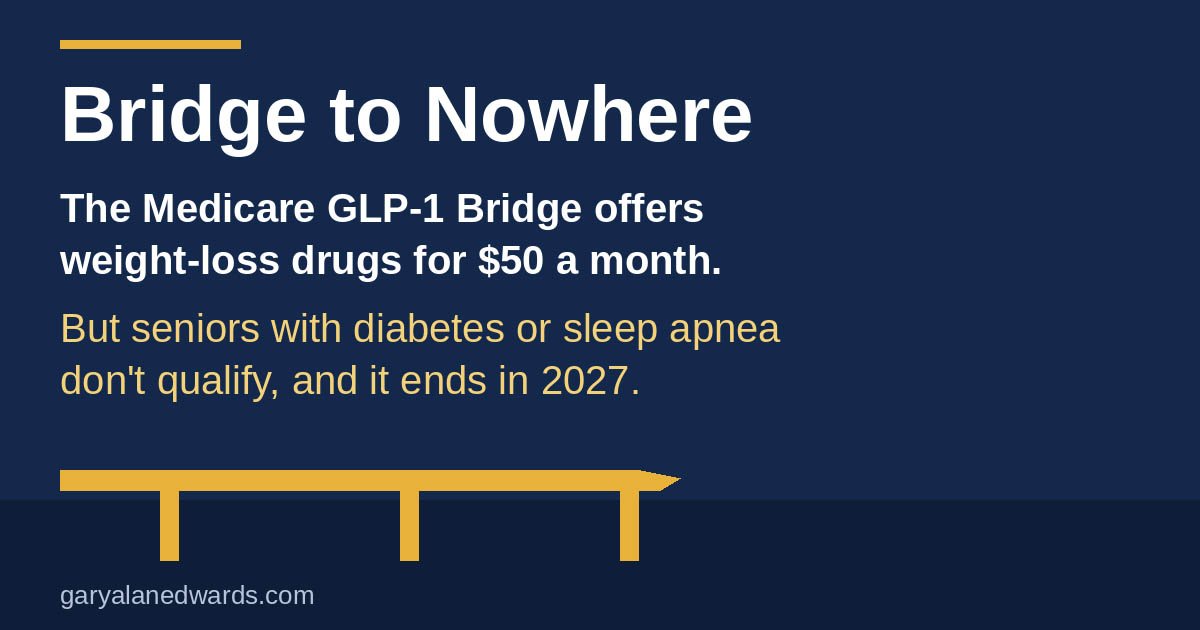
The Medicare GLP-1 Bridge sounds like great news for seniors. For the first time, Medicare helps pay for weight-loss drugs like Wegovy and Zepbound. Better yet, many people pay only $50 a month instead of $500 or more.
However, the program hides two big catches. First, it shuts out millions of seniors who have type 2 diabetes or sleep apnea along with their weight problem. Second, it ends after just 18 months. As a result, many older Americans will find that this bridge leads nowhere.
What Happened at My Doctor’s Office
I learned about these catches the hard way. In August, I went to my doctor expecting to walk out with a prescription for Foundayo at $50 a month. After about 45 minutes, however, a medical assistant came back and told me I did not qualify.
That visit sent me digging into how the program really works. What I found surprised me, and it will probably surprise you too.
What Is the Medicare GLP-1 Bridge?
The Centers for Medicare & Medicaid Services (CMS) runs the Bridge as a short-term test program. Many people heard it would start in January 2026. In fact, CMS began paying claims on July 1, 2026, and the program stops on December 31, 2027.
Here is how it works:
- Cost: You pay $50 for each monthly supply. Medicare pays the drug company the rest of a $245 monthly price.
- Drugs: The Bridge covers Wegovy, the Zepbound KwikPen and the Foundayo pill. It does not cover Ozempic, Mounjaro or Rybelsus.
- Who can apply: You need a Medicare Part D drug plan. You also need a BMI of 35 or higher, a BMI of 30 or higher plus certain heart, kidney or blood pressure problems, or a BMI of 27 or higher plus prediabetes, a past heart attack, a past stroke or artery disease.
- How you apply: Your doctor sends a prior authorization form to a CMS contractor, not to your Part D plan.
The Bridge also has some money traps. For example, the $50 copay does not count toward the $2,100 yearly cap on Part D drug costs. In addition, Extra Help (the Low-Income Subsidy) does not lower the $50 copay. Finally, you cannot use drug company coupons with it.
GLP-1 Bridge Eligibility at a Glance
| Your situation | $50 Bridge price? |
| Part D plan and BMI of 35 or higher | Yes |
| BMI 30 to 34.9 plus heart failure (preserved ejection fraction), uncontrolled high blood pressure or stage 3a+ kidney disease | Yes |
| BMI 27 to 34.9 plus prediabetes, a past heart attack, a past stroke or artery disease in the legs | Yes |
| BMI under 27 with no qualifying condition | No |
| Type 2 diabetes, moderate to severe sleep apnea or MASH | No — your Part D plan handles it at its usual copay |
| Already filled a GLP-1 through Part D in 2026 | No |
| No Part D drug plan | No |
By the way, the Bridge looks at your BMI when you started the drug, not your weight today. So if you already lost weight, you may still qualify.
The Catch: Diabetes and Sleep Apnea Shut You Out
Here is the part most seniors do not know. If you have obesity plus type 2 diabetes, you cannot get the $50 price. Likewise, if you have obesity plus moderate to severe obstructive sleep apnea, you cannot get it either. CMS also shuts out people with a fatty liver disease called MASH, and anyone who already filled a GLP-1 prescription through Part D in 2026.
CMS says these people do not need the Bridge because their Part D plan already covers GLP-1 drugs for those conditions. On paper, that sounds fair. In real life, however, Part D plans often charge copays of $200 to $600 a month for these drugs, according to doctors interviewed by KFF Health News. So “covered” does not mean “affordable.”
Consider Jeff La Marca, a 68-year-old retired professor in New Jersey. He has a BMI of 42, had quadruple bypass surgery and has prediabetes. Even so, Medicare turned down his Bridge application because he also has severe sleep apnea. In other words, the very illness that proves he needs the drug is the reason he cannot afford it.
This rule turns common sense upside down. The sickest patients, the ones with the most to gain, pay the most.
By the Numbers: Who Gets Left Behind
The numbers show just how many seniors this rule shuts out. KFF, a nonprofit health research group, studied 2023 Medicare records. It found that more people get shut out than get in.
| Medicare Part D enrollees who met the Bridge’s weight and health rules (2023) | Number of people | Share |
| Obesity only (no diabetes, sleep apnea or MASH) — eligible for $50 | 3.8 million | 39% |
| Obesity plus diabetes, sleep apnea, MASH, or already on a GLP-1 — shut out | 5.9 million | 61% |
| Total who met the weight and health rules | 9.7 million | 100% |
In short, about 6 in 10 seniors who meet the weight rules cannot get the $50 price.
Other national data help explain why the shut-out group is so large:
- Obesity: About 39% of U.S. adults age 60 and older have obesity, according to the CDC’s 2021–2023 survey.
- Obesity plus diabetes: About 23% of U.S. adults with obesity also have diabetes, according to the CDC. Diabetes rates climb with age, so the share runs higher among seniors.
- Obesity plus sleep apnea: A 2025 study of nearly 13,000 middle-aged and older adults found that about 74% of people with obesity had some sleep apnea. Many of those cases are mild, though, and only moderate to severe cases block you from the Bridge.
One honest note: KFF has not published a separate count of how many shut-out seniors have diabetes versus sleep apnea. Many people have both, so the groups overlap.
The 18-Month Cliff
Even seniors who qualify face a second problem. The Bridge ends on December 31, 2027, and CMS has named no program to replace it. CMS first planned a longer-term plan called the BALANCE Model. However, CMS put it on hold after major insurers refused to join.
That end date matters because these drugs only work while you take them. Research makes this clear:
- In the STEP 1 study, people who stopped Wegovy (semaglutide) regained about two-thirds of their lost weight within one year.
- In the SURMOUNT-4 study, people who stopped Zepbound (tirzepatide) regained about 14% of their body weight within a year, while those who stayed on it kept losing.
- In both studies, blood sugar and blood pressure gains also faded after people stopped.
Doctors now treat obesity as a lifelong disease, much like high blood pressure. Nobody would take a blood pressure pill for 18 months and then quit. Yet that is exactly what the Bridge asks seniors to do. Consequently, many people could lose weight in 2026 and 2027, only to gain it back in 2028.
Who Really Wins? Follow the Money
Nobody outside CMS knows for sure why it wrote these rules. In my view, however, Big Pharma likely helped shape them to protect its profits. The facts below explain why I suspect this.
First, the Bridge grew directly out of a November 2025 deal between the White House and the two drug makers, Eli Lilly and Novo Nordisk. In exchange, the companies gained a huge new Medicare market. Second, Medicare already spent $27.5 billion on GLP-1 drugs through Part D in 2024, all for diabetes, heart, liver or sleep apnea uses. That existing market stays untouched by the $50 deal. Third, the seniors with diabetes or sleep apnea are exactly the people most likely to stay on these drugs for life. By keeping them in regular Part D, the system collects far more from them each month than $50.
Meanwhile, the drug makers still profit from the Bridge itself. One Wall Street analyst estimated that early Bridge use alone could bring Lilly $900 million to $1.2 billion in yearly sales.
Other Possible Reasons for the Exclusion
To be fair, no public record shows that drug companies asked for the diabetes and sleep apnea rule. In fact, the original 2025 deal promised a lower $245 Medicare price for diabetes uses too. Several other reasons could explain the rule:
- Medicare would pay twice. Part D already covers GLP-1 drugs for diabetes and sleep apnea. CMS built the Bridge for people who have no other way to get these drugs. Paying through a second program for patients Part D already covers would waste money.
- The law ties CMS’s hands. Federal law still bans Medicare from paying for drugs used only for weight loss. CMS created the Bridge under a special short-term “demonstration” power. CMS designed it to fill a gap, not to repeat coverage that Part D already provides.
- Cost to taxpayers. KFF estimates the Bridge could cost Medicare between $1.3 billion and $10 billion, depending on how many people sign up. Adding 5.9 million more people would add billions more.
- Stopping insurers from shifting costs. Without the rule, Part D plans could steer their diabetes and sleep apnea patients into the Bridge. Then taxpayers, not insurers, would pick up the bill. KFF says CMS wrote the limits partly to stop this shift.
- Protecting Part D premiums. Insurers set their 2026 premiums before the Bridge began. CMS said the Bridge will not raise premiums because plans pay nothing toward it. Moving millions of current patients out of their plans could upset those numbers.
- Clean test results. CMS wants to learn whether treating obesity alone saves Medicare money over time. Mixing in diabetes patients, who already get the drugs, would muddy that answer.
Each of these reasons makes sense on paper. Meanwhile, insurers point the finger at drug makers’ high prices. None of these explanations, however, changes the result for patients.
Whatever the reason, someone designed a program that charges the sickest seniors the most. Did Big Pharma push for that, or does it simply benefit from it? Readers can decide. Either way, the patient loses.
What You Can Do Now
If you want a GLP-1 drug on Medicare, take these steps:
- Ask your doctor which path fits you. The Bridge looks at your BMI when you started the drug, not your weight today. Your doctor must also confirm whether you have diabetes, sleep apnea or MASH.
- Compare Part D plans before December 7. Medicare open enrollment runs from October 15 to December 7. If the Bridge shuts you out, pick the plan with the lowest copay for your GLP-1 drug.
- Check Extra Help. Extra Help does not lower the Bridge copay, but it does lower Part D copays. For some low-income seniors, regular Part D may cost less.
- Compare cash prices. Lilly and Novo Nordisk sell some doses directly to patients. Check those prices, but remember you cannot mix them with the Bridge.
- Plan for 2028. Talk with your doctor now about what happens when the Bridge ends.
- Call Congress. Only Congress can lift the law that bans Medicare from covering weight-loss drugs. Tell your senators and representative that seniors need lasting, fair coverage.
Frequently Asked Questions
What is the Medicare GLP-1 Bridge?
It is a temporary Medicare test program that runs from July 1, 2026, through December 31, 2027. Eligible Part D members pay $50 a month for Wegovy, the Zepbound KwikPen or Foundayo when a doctor prescribes it for weight loss.
Does the Bridge cover GLP-1 drugs for sleep apnea?
No. If you have moderate to severe sleep apnea, type 2 diabetes or MASH, the Bridge turns you away. Instead, your regular Part D plan covers the drug at its usual copay, which often runs hundreds of dollars a month.
Can I get Foundayo for $50 a month?
Yes, if you meet the BMI and health rules and you do not have diabetes, sleep apnea or MASH. You also cannot have filled a GLP-1 through your Part D plan in 2026.
What happens after December 2027?
Nobody knows yet. CMS planned a longer program called the BALANCE Model, but it put that plan on hold in April 2026 after insurers refused to join. Right now, no replacement exists, so many patients could face a gap in coverage.
Does the $50 copay count toward my Part D out-of-pocket limit?
No. The Bridge runs outside Part D, so the $50 does not count toward the $2,100 yearly cap. In addition, Extra Help does not lower it.
The Bottom Line
The Medicare GLP-1 Bridge helps about 3.8 million seniors, and that is real progress. Nevertheless, it leaves out 5.9 million others, many of them sicker. Then, after just 18 months, it ends for everyone. Since these drugs only work as long as you take them, a short-term program cannot fix a lifelong disease. Until Congress acts, the Medicare GLP-1 Bridge remains a bridge to nowhere.
Sources
- KFF: Nearly Four Million Medicare Beneficiaries Met the Eligibility Criteria for the Medicare GLP-1 Bridge (June 2026)
- KFF Health News: The Medicare GLP-1 Discount Has One Big Catch (August 2026)
- CBS News: Medicare GLP-1 coverage starts July 1
- AARP: Does Medicare cover weight-loss drugs?
- Healthie: Medicare’s GLP-1 Bridge Demonstration (BALANCE Model delay)
- Pharmaceutical Commerce via Pulse: What the Medicare GLP-1 Bridge Means for Pharma ($27.5 billion Part D spending)
- Fierce Pharma: Bridge uptake and Lilly sales estimate
- Axios: Trump announces Medicare coverage of weight-loss drugs (November 2025 deal)
- Medical Economics: CDC obesity prevalence 2021–2023
- ABC News: CDC obesity report (23% of adults with obesity have diabetes)
- eClinicalMedicine 2025: Obesity and obstructive sleep apnea in 12,860 adults
- Barbell Medicine: Weight regain after stopping GLP-1s (STEP 1 extension and SURMOUNT-4 summary)


0 Comments